Let's Make Your Dreams A Reality
We can help you with your Project
Smart SMS-Based Poultry Monitoring System
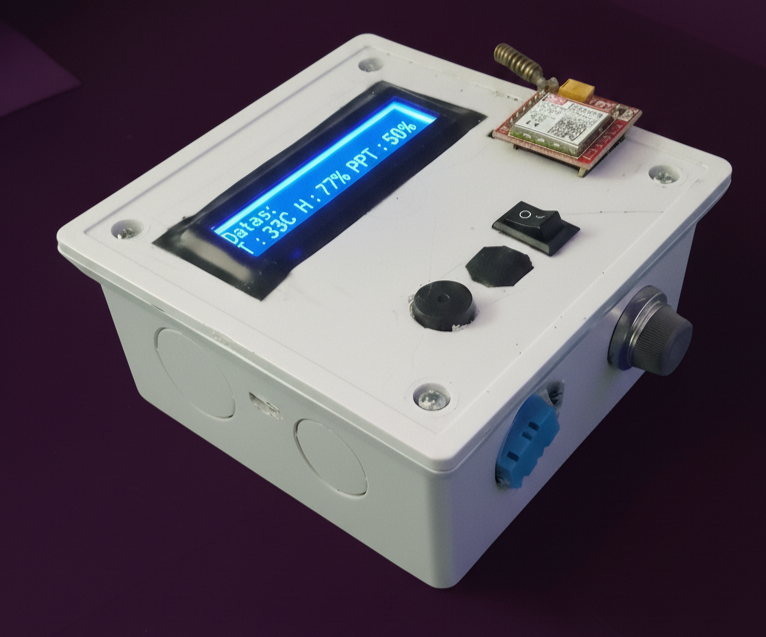
Smart SMS-Based Poultry Monitoring System
Project Overview
The Smart SMS-Based Poultry Monitoring System is an innovative embedded solution designed to help poultry farmers monitor critical environmental parameters that affect the health and productivity of day-old chicks. The system automatically tracks temperature, humidity, ammonia levels, and the number of rearing days, providing real-time alerts via SMS notifications whenever conditions exceed safe thresholds.
This project aims to improve poultry management through automation, ensuring optimal living conditions that minimize chick mortality, prevent diseases, and promote healthy growth.
Problem Statement
Maintaining an ideal environment in poultry farms—especially for day-old chicks—is crucial but often difficult for small- and medium-scale farmers. Excessive heat, high humidity, and ammonia buildup from droppings can quickly lead to poor health or death among the chicks. Traditional manual monitoring methods are time-consuming and prone to error.
Hence, there is a need for an automated, affordable, and reliable monitoring system that provides remote alerts for timely intervention.
Objectives
-
To design a system that continuously monitors temperature, humidity, and ammonia levels in poultry houses.
-
To implement threshold-based alerts using a GSM module that sends SMS notifications to the farmer’s phone.
-
To improve poultry health and reduce chick mortality through proactive monitoring.
-
To enhance farm management efficiency by providing real-time environmental data.
System Components
Hardware Components
-
Microcontroller (ESP32/Arduino): Acts as the brain of the system, processing sensor data and controlling communication.
-
Temperature and Humidity Sensor (DHT22): Measures environmental temperature and humidity levels.
-
Ammonia Sensor (MQ-137): Detects harmful ammonia gas concentration within the poultry house.
-
GSM Module (SIM800L/SIM900): Sends SMS alerts to the farmer’s mobile phone when thresholds are exceeded.
-
Power Supply Unit: Provides stable DC voltage to all components.
-
LCD Display (optional): Shows real-time readings for local monitoring.
Software Components
-
Embedded C/C++: Used for coding the microcontroller to interface with sensors and GSM module.
-
Arduino IDE / ESP-IDF: Development environment used for programming and debugging.
-
Fritzing: Used for circuit schematic and PCB layout design.
System Design and Operation
The system collects data from sensors at regular intervals. Each sensor reading is compared against predefined safe limits:
-
If the temperature exceeds the upper threshold, an SMS alert is sent indicating “High Temperature Detected.”
-
If humidity is too high or too low, an alert prompts ventilation adjustment or misting.
-
When ammonia levels rise beyond safe limits, the system notifies the farmer to increase ventilation or clean droppings.
Additionally, the system keeps track of the number of rearing days and can send periodic updates to help the farmer manage feed and vaccination schedules.
All sensor readings are processed in real time, and the farmer receives immediate feedback through the GSM network, ensuring timely corrective actions.
Circuit Design
The circuit integrates all sensors and communication modules with the microcontroller. Power is supplied via a 5V regulated source. Each sensor connects to analog or digital pins, while the GSM module communicates using serial (UART) protocol. The circuit layout and simulation were designed using Fritzing and Proteus tools before physical implementation on a breadboard or PCB.
Testing and Results
The system was tested in a controlled poultry environment for several days.
-
The DHT22 sensor accurately reported temperature and humidity variations.
-
The MQ-137 sensor responded to increased ammonia concentrations.
-
SMS alerts were received within 5–10 seconds after thresholds were crossed.
Overall, the system performed reliably, confirming its capability for real-world poultry monitoring applications.
Challenges and Solutions
-
Challenge: GSM network delays in rural areas.
Solution: Implemented retry mechanisms and signal strength checks in the code. -
Challenge: Power fluctuations affected sensor stability.
Solution: Added voltage regulators and capacitors for noise filtering. -
Challenge: Sensor calibration required for accuracy.
Solution: Calibrated sensors using standard laboratory conditions.
Project Impact
This system provides farmers with a cost-effective, low-maintenance, and scalable way to monitor poultry environments.
It reduces manual labor, prevents losses due to extreme conditions, and supports data-driven decision-making for farm management.
Future Enhancements
-
Integration with IoT platforms for cloud-based monitoring and analytics.
-
Addition of mobile app notifications alongside SMS.
-
Implementation of automatic ventilation and misting control for a closed-loop system.
-
Solar power integration for off-grid farms.
Skills Demonstrated
-
Embedded Systems Design
-
IoT & Sensor Integration
-
GSM Communication & Networking
-
Control Systems Engineering
-
Circuit Design & Simulation (Fritzing, Proteus)
-
Embedded C++ Programming
-
System Debugging and Troubleshooting
-
Technical Documentation and Reporting
-
Attention to Detail & Problem Solving
Conclusion
The Smart SMS-Based Poultry Monitoring System demonstrates how embedded technology and communication systems can revolutionize modern farming. By automating environmental monitoring and enabling real-time alerts, this project contributes to sustainable poultry farming and improved livestock management through intelligent IT integration.
Related Projects